
Boat Storage Near Saylorville Big Creek and Lake Petocka
Boat Storage Near Saylorville Big Creek and Lake Petocka
Tom Gustafson
August 11th, 2026
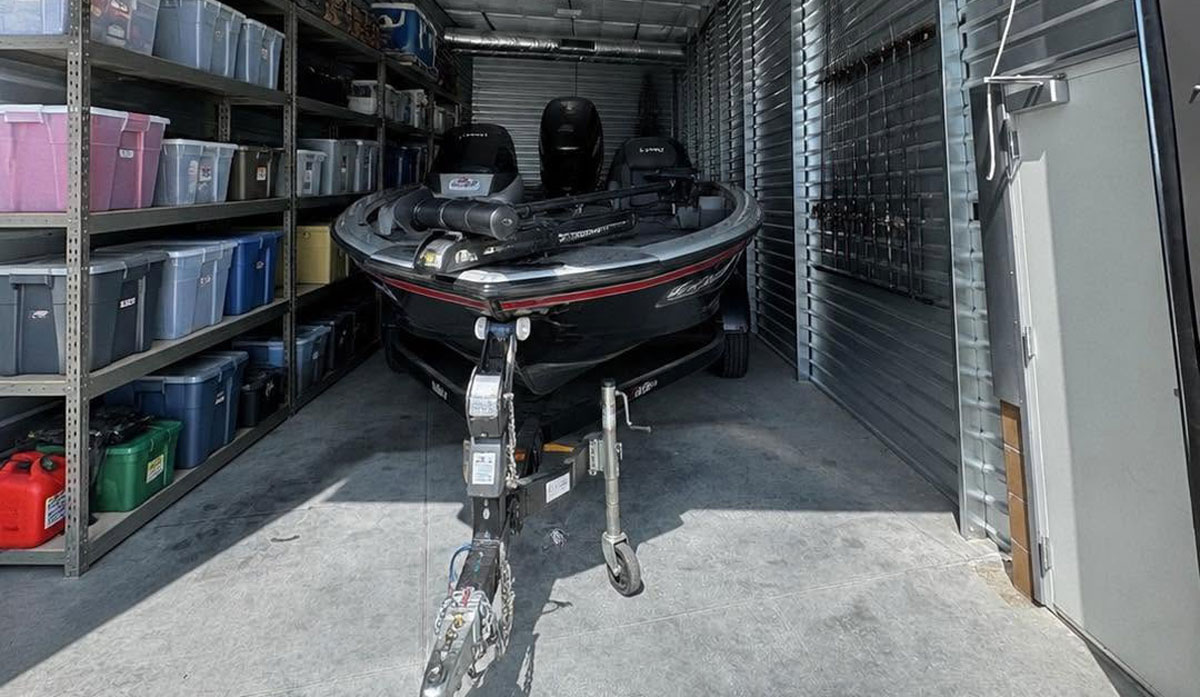
The three lakes closest to Bondurant run under three different rule sets, and which one you use should shape how you store your boat. Lake Petocka, right here in town, is a 19-acre city fishing lake open to non-motorized craft only, hand launched, so there is no ramp for a trailer. Big Creek Lake at Polk City takes any size motor but holds the entire lake to 5 mph, which makes it a fishing, sailing, and cruising lake rather than a ski lake. Saylorville is the open water, and it is a flood-control reservoir, so ramps close when the river comes up. Whichever you run, the boat spends most of its life on a trailer, and it needs somewhere dry and secure inside an easy tow of the ramp you actually use.
Key takeaways
- Lake Petocka is non-motorized and hand-launch only. Lovely water, but you are not backing a trailer down it.
- Big Creek allows any size motor at 5 mph across the whole lake, so there is no legal way to pull a skier.
- Saylorville is where the open-water boating happens, and its ramps close on high water.
- Cleaning the boat and pulling the drain plug at the ramp is Iowa law, and it happens to be the right way to put a boat into storage.
- Storage here is not only a winter problem. A wet June can take your ramp away in the middle of the season.
Three lakes, three different sets of rules
I keep a boat, so I have had this conversation in our driveway more than once. Somebody buys a wake boat in April, gets it home, and finds out in June that the lake they had pictured using it on caps everybody at idle speed.People treat the water around here as a single thing. Central Iowa boating, close enough. But Petocka, Big Creek, and Saylorville answer to three different authorities under three different rule sets, and the gap between them is the difference between a good summer and an expensive misunderstanding. Here is the plain version of each, and then what it means for where you keep the boat.
Can you launch a boat at Lake Petocka?
Not a trailered one. Petocka sits a few minutes from us and it is a genuinely good little lake, but the Iowa DNR lists it at 19 acres with a carry-down launch and non-motorized craft only, and that includes electric. You carry it in or you do not go. That means a kayak, a canoe, or a paddleboard.I want to be straight about this, because we sit about 1,500 feet from that water and it would be easy to let people assume more than is true. If you own a pontoon, Petocka is not your lake. If you own a kayak and live in Bondurant, it is close to perfect. It gets stocked with trout in the cold months, the bluegill are good, and the catfish run genuinely large. The DNR also has rusty crayfish logged in it, which is worth knowing before you get to the cleaning rules further down.The storage angle here is small and I am not going to pretend otherwise. Kayaks and paddleboards want a garage wall, not a bay, and you should not be renting from me for those.
What can you actually do on Big Creek Lake?
Big Creek is the one people get wrong. It is a real lake up at Polk City, five ramps, a marina, the biggest beach in the state park system. Any size motor is allowed. What catches people is that the whole thing is held to 5 mph, shore to shore, all season. The rule sits in the park's own map and flyer, and the DNR page for Big Creek State Park covers the rest.For what it is, it is superb. Walleye and crappie and muskie, a sailing club that exists precisely because the water stays flat, and pontoon weather most of the summer. What it will not do is pull anybody, and every year somebody works that out with a new boat already in the water and a kid standing on the swim deck in a life vest.Worth knowing if you boat there regularly: the park rents dry-dock spaces at the northeast corner through the park office. If your boat lives at Big Creek and never goes anywhere else, that is a legitimate option and you should look at it before you look at me.
What about Saylorville?
Saylorville is the open water, and it is why there are ski boats and jet skis in driveways all over Bondurant and Altoona. It is also not a lake in the way people usually mean the word. It is a flood-control reservoir on the Des Moines River run by the Army Corps of Engineers, built to hold back water first and hold boats second.That matters more than it sounds. The Corps keeps the pool at 836 feet through the year, and the lake is engineered to climb to 890 in a flood. No natural lake has that range. Get a heavy stretch of rain up the watershed and ramps start closing, debris comes down the river, and the Corps will tell people to stay off the water altogether. It has happened in June, in July, and over a Fourth of July weekend.Before you hitch up, look at the Saylorville recreation status page, which lists every ramp by name and whether it is open. Two minutes on your phone beats forty minutes of towing to a chain across the ramp.
Clean, drain, dry, then store
Whichever lake you came off, the next ten minutes are law rather than advice. It is also the step people rush hardest, because they are tired and the truck is already running.Before you leave any water access in Iowa you have to clean visible plants and mud off the boat and the trailer, then drain everything that holds water: bilge, live well, motor, ballast. The drain plug comes out at the access and stays out while you tow, not when you get home. Before the boat goes to a different lake, the DNR wants it sprayed with hot, high-pressure water or dried for five days.Here is why that belongs in a storage post. Every one of those steps is also just the right way to put a boat away. Water left in a ballast bag through an Iowa winter freezes and splits things that cost real money. A hull put away damp, with weed still hanging off the trailer bunks, comes out in April smelling like a pond, and that smell gets into upholstery and stays. With the plug out, meltwater has somewhere to go instead of sitting in the bilge until March.The DNR tells people to check hulls and lifts for zebra mussels when they pull everything for the winter, and that timing is not an accident. Fall is the one stretch of the year when the whole boat is out of the water and dry enough to look at properly. Run a hand over the smooth surfaces while you are covering it. Juvenile mussels feel like sandpaper before you can see them.
What the lake you use changes about storage
Every one of these is a trailer lake. Petocka has no slip, Big Creek's dry dock only makes sense if that is the only water you run, and most people around here launch, run, and haul out inside the same day. So the boat lives on a trailer nearly all the time, and where that trailer sits is the real decision.What that argues for is not complicated. Somewhere on your side of the metro, so a spur-of-the-moment Saturday does not open with a forty-minute detour the wrong way. A hard surface, because a trailer left on gravel through an Iowa spring settles into it, and digging out a tongue jack is a miserable way to start a season. And power. A maintainer running through the winter is the difference between turning the key in April and buying a battery in April.
Storage here is not only a winter problem
Most storage writing treats a boat as something you put away in October and drag out in April. Around here that is only half right.Saylorville can take your ramp away in the middle of the summer. Big Creek's concession and marina run roughly mid-April to mid-October, weather depending. Add a stretch of work travel or three wet weeks and there are in-season stretches where the boat is not going anywhere, and it should not spend them in the driveway taking sun and hail.One thing worth putting on the calendar while it is away. Iowa registrations run in three-year cycles and expire April 30, and an expired decal keeps you off public water, which is a rotten thing to discover at the ramp on the first warm Saturday of the year. That same DNR page carries an affidavit to store a registered vessel through the off-season, and hardly anybody knows it is there.
Where our facility fits
Dynamic Storage Spaces XL is in Bondurant, a straight shot to Saylorville's east-side ramps and a reasonable run up to Polk City. Units are enclosed and run 14x35 to 18x50. The aisles are 65 feet of concrete, every unit has power for a maintainer, and the lighting is motion-sensor, which you notice in late October when it is dark at both ends of the day. Measure to the top of the tower rather than the gunwale before you pick a size, because the tower is what has to clear the door. Sizes and rates are on the availability and pricing page, and if you are weighing an enclosed unit against an open lot or your own driveway, we worked through that in enclosed versus outdoor storage. Directions from Altoona, Ankeny, and Pleasant Hill are on the site.
Frequently asked questions
Can I take a motorboat on Lake Petocka?
No. The DNR lists Petocka as non-motorized only, including electric motors, and hand launch only. It is a paddling and shore-fishing lake. For anything with a motor you are going to Big Creek or Saylorville.
Can you water ski or wakeboard on Big Creek?
No. Big Creek holds the whole lake to 5 mph regardless of motor size, so there is no legal way to pull anyone. Saylorville is where that happens.
Why do Saylorville ramps close in the summer?
Because it is a flood-control reservoir first. When heavy rain moves through the Des Moines River watershed the pool rises, and the Corps closes lower ramps and beaches for safety and because of debris coming downriver. Check the recreation status page before you tow.
Do I really have to pull the drain plug before I tow?
Yes. Iowa requires drain plugs to be removed at the water access and left open during transport, along with draining the live well, bilge, and ballast and cleaning plants off the boat and trailer. It is enforced, and it is also the right way to put a boat away.
Should I keep the boat on a battery maintainer in storage?
If the unit has power, yes, and it is one of the better reasons to pay for a powered unit. A battery that sits through an Iowa winter with nothing on it is frequently a battery you replace. Follow your battery maker's guidance on the right maintainer for your setup.
Figure out your lake, then figure out your storage
If you are shopping for a boat, settle which of these three you will actually run it on before you buy, because that choice binds harder than the boat does. If you already own one, the only question left is where it sits the rest of the week. Check what is available and what it costs, or call (515) 827-4545 and come look at a unit with the trailer behind you. We answer our own phone.
Categories